
Healthy Seminarians Healthy Church
  • About Us
    • History/Vision/Values
    • Staff & Board
    • Press & News
  • Seminarians
    • Overview
    • HSHC @ CTS
  • Congregations
    • Overview
  • Research and Advocacy
    • Overview
    • Health & Wholeness Assessment
  • Blog
  • Resources
    • Overview
  • Contact Us
  • Donate
    • Donate Now
01
Jun
From The Ground Up: Digging Deeper Into Our Body-Garden Connection

By: Karen Webster

body connection garden health

Comments: 0

From The Ground Up: Digging Deeper Into Our Body-Garden Connection

Over the last several years, there has been a significant increase in the number of articles that discuss the health benefits that people can gain through gardening – opportunities for movement and relationship development, improved mental and spiritual wellbeing, chances to grow local/sustainable food, among other things – which is wonderful.  As a gardener myself, I can attest to some of the health benefits I have personally received.

As a result of this recent attention, I have found myself increasingly drawn towards reflecting on our body-garden connection, particularly because I find that so many articles (not all) touch only on the surface-level health benefits of gardening, thus missing the richness that can come from digging more deeply into why there is such a strong connection.  

So, why is gardening so good for our health?

1. I think it’s because what both our bodies and plants need to thrive are essentially the same!  And, really, this shouldn’t be any surprise given that our lives started in a garden: 

“And the Lord God planted a garden in Eden, in the east; and there he put the man whom he had formed.  Out of the ground the Lord God made to grow every tree that is pleasant to the sight and good for food, the tree of life also in the midst of the garden, and the tree of the knowledge of good and evil.” ~Genesis 2:8-9

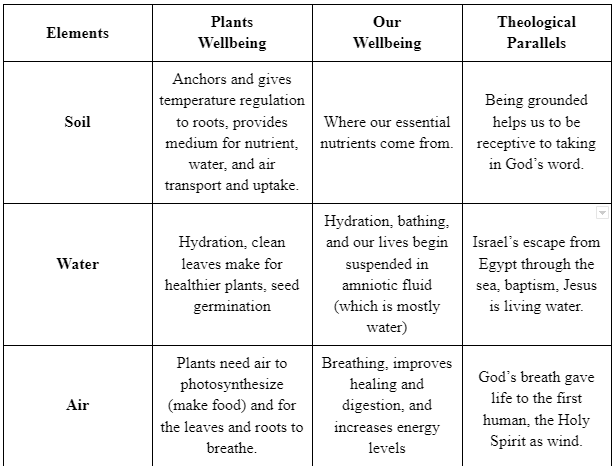
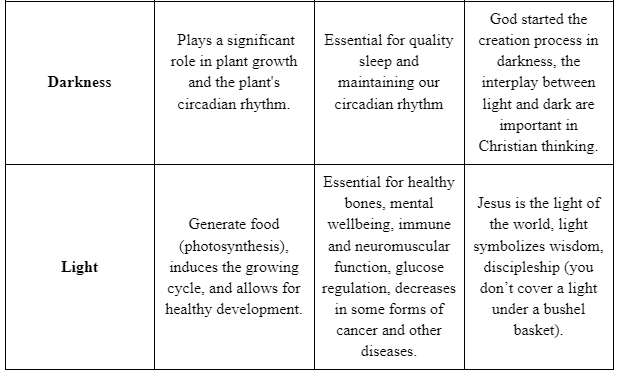
Because people and plants share the same basic needs, and since humans and gardens have such a long-standing relationship, it should be no surprise that there are notable theological parallels that illuminate this connection.

I have read that Jesus used agricultural illustrations because this is what people knew.  However, equally important, and not frequently discussed, is the fact that there is, indeed, a fundamental link between people and plants.  I believe this chart, which is far from an exhaustive comparison, is a case in point of this deep connection!

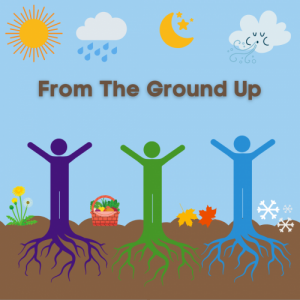
2.  People and plants are both deeply impacted by what season of life they are experiencing.  Spring, summer, fall, winter… new growth, maturation, flower/harvest, dormancy.  Plants and people alike experience different seasons, and each season presents different needs.  Paying attention to these changes, and the needs that come with them, is crucial for how we attend to the wellbeing of both our gardens and our lives: daily, weekly, monthly, yearly.  

In the midst of this familiar rhythm and shared commonality of each season, then, there is also a uniqueness in the needs each season presents and, thus, how we are called to tend to ourselves in each season that plays a vital role in our collective wellbeing.

As we move through different seasons, it becomes important for us to consider some important questions, such as:

  • What was used up in the previous season?
  • What do we need to be particularly mindful of during this season?

For example, some plants have especially intense nutrient needs – such as nitrogen, phosphorus, and potassium – at particular times, while others use up lesser amounts.  Thus, proper fertilization and crop rotation are essential for a healthy garden.  As people, we, too, have certain needs at certain times.  Family expectations, work obligations, health/medical challenges, celebrations (graduations, weddings, reunions), experiences of loss and/or difficult transitions (jobs, retirement, moving, death), all may bring with them different requirements, meaning how we tend to ourselves in them may change.  

As such, it is important for us to make an assessment  of how we are doing on a regular basis.  What aspects of our wellbeing (physical, mental, emotional, spiritual, relational, etc.) are feeling parched or malnourished?  What are we pleased with?  What needs might require attention soon?  Just as a garden needs regular care, so do we!  (Click here if you would like to utilize our wellness assessment.)

3. Both people and plants need others to thrive!  

In a garden, there are certain plants that get along well with each other.  This is the concept of companion plants.  Each has a role in the garden’s collective wellbeing.  Some attract pollinators, others suppress weeds, others ward off “bad” bugs, while others provide shade.  Essentially, companion plants grow well together, each contributing to the good of the other.  Thus, intentionally increasing the diversity of plants increases the health of the garden.

Likewise, we need people in our lives who will help us to enrich our experience, show us new ways of thinking, expose our blind spots, and generally round out our human experience.  Moreover, we also need to be willing to do this for other people, too.  As with a garden, “mono-culture” is also detrimental to humans as we move through life’s various seasons.

As we enter into the summer season, I want to challenge you to do some digging around in your figurative and/or literal garden and ask yourself:

  • Which of the basic elements do you feel called to tend to this season?
  • What sort of companion (plants) do you need? 
  • What are you uniquely able to contribute to others?

May all be well,

Karen H. Webster

HSHC Co-founder/Executive Director

30
May
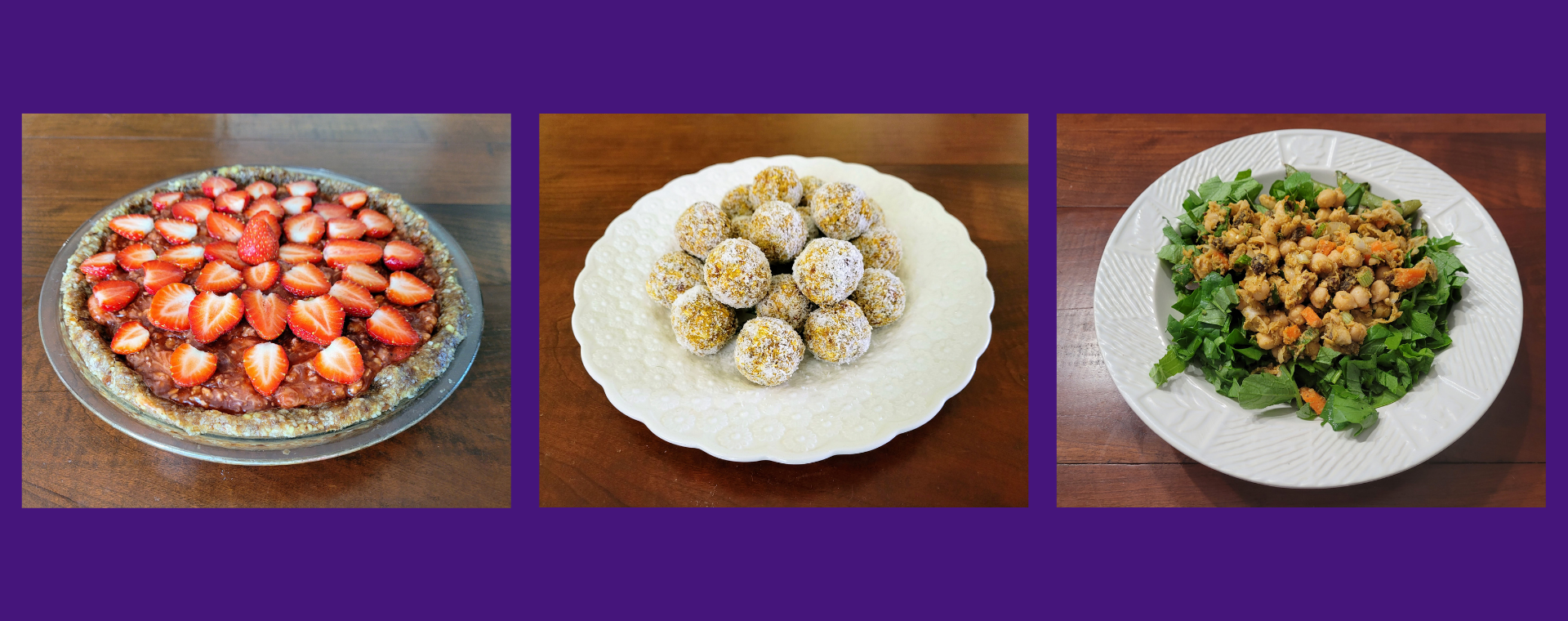
Three recipes for the start of summer that each have biblical roots!

By: Karen Webster

bible recipe summer vegan

Comments: 0

Three recipes for the start of summer that each have biblical roots!
Try out these seasonal and flavorful dishes for a refreshing meal or snack this summer.
 
 
No-Bake Strawberry Pie
  • 2 Samuel 6:19 (NRSV) – “[David] distributed food among all the people, the whole multitude of Israel, both men and women, to each a cake of bread, a portion of meat,[a] and a cake of raisins. Then all the people went back to their homes.”
Lemon Turmeric Energy Balls
  • Genesis 43:11 (NRSV) – “Then their father Israel said to them, “If it must be so, then do this: take some of the choice fruits of the land in your bags, and carry them down as a present to the man: a little balm and a little honey, gum, resin, pistachio nuts, and almonds.”
Best Curried Chickpea Salad
  • Numbers 11:5 (NRSV) – “We remember the fish we used to eat in Egypt for nothing, the cucumbers, the melons, the leeks, the onions, and the garlic.”

Recipes from T. Colin Campbell Center For Nutrition Studies, Natalie’s Health, and The Simple Veganista.

Health of Seminarians Research Findings Spring 2022

By: Karen Webster

health research seminarians seminary

Comments: 0

Health of Seminarians Research Findings Spring 2022

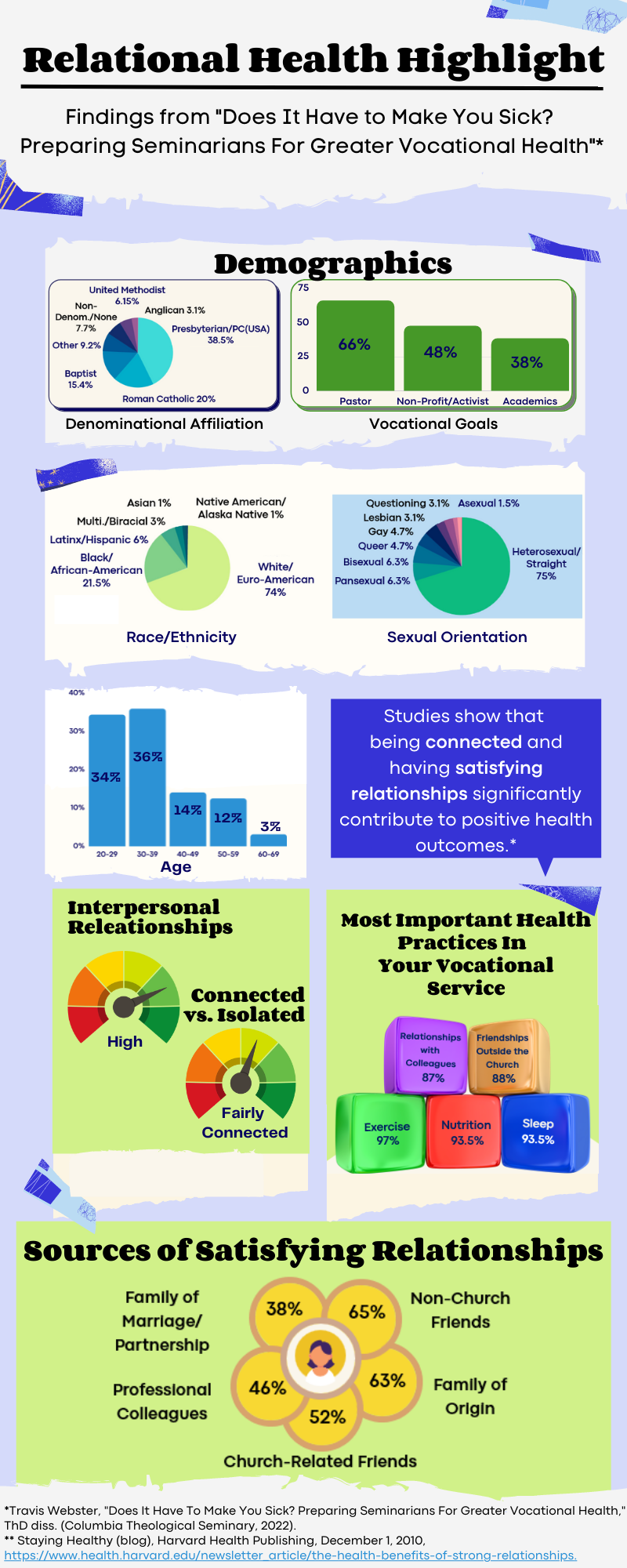
One of our commitments as an organization is to conduct research specifically focused on the current state of seminarian health and wholeness.  In the summer and fall of 2020, Travis Webster (HSHC co-founder) conducted his dissertation research study* among seminarians who attend Christian seminaries and divinity schools in the United States.  The purpose of his study was to explore whether the factors that contribute to pastoral unhealth are already present in pastoral formation. 

 
One aspect of seminarian health that we want to highlight from Travis’ dissertation research is their relational health: 
  • Survey participants scored high on interpersonal relationships.
  • They felt fairly connected to others.
  • 2 of the 5 most important health practices that they want to be attentive to in their vocational service are relationship oriented.  
This is good news for several reasons:
  • Research is continuing to show how relational health significantly impacts one’s overall health*, which is why we, as an organization, have increasingly focused on providing tools and resources for seminarians and others to use to tend to this area of wellbeing.
  • Relational health is something that clergy struggle with, so we are pleased that these seminarians are being attentive to this aspect of being well!  
To get a quick snapshot of these findings, as well as an overview of some of the participants’ demographic information, check out this infographic.

Note: very little research has been done on the health of seminarians.  Therefore, we believe that the information Travis has gathered will positively contribute to addressing the overall health and wellbeing of seminarians, clergy, and congregations.  

13
Apr
Trail Notes Spring 2022: Actively Working Towards Becoming MORE Contagious!

By: Karen Webster

church contagious health wellness

Comments: 0

Actively Working Towards Becoming MORE Contagious!

When you see or hear the word “contagious,” what comes to mind?  COVID?  Masks? Other forms of infectious diseases or illnesses?  Something unpleasant?  Death?  Given what we’ve been through over the past two years, it is quite understandable to have these kinds of thoughts.  

However, it is also important to remember that some things that are “contagious” are positive and are, thus, good for our health when they spread.  These include (but are not limited to!) a smile, laughter, words of gratitude, and/or other forms of compassion.

At its root, to be contagious means that an influence, quality, or nature has the ability to spread rapidly through verbal and/or physical contact with those around us.  Again, this can work for good or for bad.

As some of you know, the very reason we exist as an organization is to promote positive contagion, particularly when it comes to spreading healthy lifestyle practices among seminaries and communities of faith.  Our primary goal is to bring about greater health and wellbeing among seminarians (many of whom are future clergy) so that they can ultimately be partners with us in spreading healthy habits – not only in the settings to which God has called them, but also in our communities and throughout the world!

However, one of the themes that came up in Travis’ dissertation research, which focused on identifying what contributes to the health and unhealth of those preparing for a vocation in ministry (the results of which were generally consistent with Karen’s doctoral research project, also conducted among seminarians six years ago), is that when it comes to talking about health, the Church is pretty much silent.

In fact, it turns out that, among the seminarians who were interviewed by Travis in fall 2020 and spring 2021, “five of the [thirteen] interview participants said they had never heard health discussed in church, either theologically or practically, and of the eight who had, it was generally limited to a particular aspect of health, usually spiritual health.  Furthermore, several interviewees indicated they had heard health talked about in church only because of the COVID-19 pandemic, meaning that, only two years ago, the number of interviewees who had never heard health come up in church would have been higher.  What an unfortunate statement about the importance of health in church that it has taken a global pandemic to bring the subject to the forefront in some congregations!”

We think there is no better time than now – in this season where we celebrate the good news of Jesus Christ’s resurrection and the new life that is given to all, to work towards changing this reality, and we would like your help!  

As we continue to empower seminary students, we  want to challenge you to help break the silence about health in our communities of faith.  When we work together, we can make a real difference in our own lives as well as in the world around us.


Peace,

Karen and Travis Webster

HSHC Co-founders

Don’t know where to start?  Check out our 3 Ways to Spread Good Health in Our Communities of Faith post for ideas and next steps.

13
Apr
3 Ways to Spread Good Health in Our Communities of Faith

By: Karen Webster

church healthy ministry

Comments: 0

3 Ways to Spread Good Health in Our Communities of Faith


  • Be contagious in worship by designating particular Sundays to highlight and explore various aspects of health (mental, emotional, physical, relational, spiritual, environmental, and more!).  There are many health-awareness calendars online that can help guide you.  For some examples specific to the United States, click here.  For some international options, click here.  


  • Be contagious in educational opportunities by offering health-oriented studies.  Something we have discovered, both in our research and through leading classes in congregational settings, is that there is a general lack of understanding of the body from a biblical and theological perspective, which significantly impacts how we treat our bodies (individually and collectively).  Since Christianity is rooted in the embodiment of Christ, and given current social movements as they relate to body image, body positivity, body shaming, etc., we think this topic is extremely relevant and foundational for congregation health ministry initiatives.  Here are a couple of books that we find to be helpful in exploring this topic:
    • Embracing The Body: Finding God in Our Flesh and Bone, by Tara M. Owens
    • Reclaiming The Body in Christian Spirituality, edited by Thomas Ryan
    • Body: Biblical Spirituality For the Whole Person, by Paula Gooder


  • Be contagious in mission and fellowship events.  Does your congregation already provide yoga classes?  Exercise groups?  A food pantry?  Fellowship opportunities?  A lot of times, it is easy to think of these, and similar pursuits, simply as events that take place at the church or ministries supported by the church.  However, many of these activities are already improving the health and wellbeing of the congregation and/or the community.  Therefore, one strategy we want to encourage congregations to consider is exploring and defining a theological basis for health (in your context) and then tying these already existing health ministries into that theology.  Your congregation may find that they don’t necessarily need to add many new programs and/or events; rather, it is simply a matter of being more intentional about the why of what you are doing.


Would you like some more ideas?  Have stories about what has been successful in your congregation?  We’d love to hear from you!  Click here to contact us.

Peace,

Karen and Travis Webster

HSHC Co-founders

* Please note: following any of the links in this post will take you to sites containing third-party content.

08
Apr
Three recipes for celebrating Earth Day or any other springtime gathering!

By: Karen Webster

lent recipe vegan

Comments: 0

Three recipes for celebrating Earth Day and spreading healthy habits this spring!
Try out these easy and delicious party foods great for sharing with a group or adding to dinner.
 
 
Cauliflower “Wings”
 
Zucchini Wraps with Kale Pesto
 
Sundried Tomato & Basil Pinwheels


Recipes from earthday.org, The Simple Veganista, and Minimalist Baker.

07
Mar
A Few of My (Newest) Favorite Ministry Tools and Online Resources*

By: Karen Webster

church education ministry tools

Comments: 0

A Few of My (Newest) Favorite Ministry Tools and Online Resources*

While January is sort of a let-down month for some people, I, personally, find it to be one of my favorite times of the year. With all of the hopes and possibilities that lie before me, I experience it to be quite energizing! Since, over the last several years, this has paired up with the beginning of the 16-week marathon training plans I began each January, I need all the energy I can get.

This year, however, I chose to take on a different kind of “marathon training plan.”

Rather than physically train in order to run a marathon, I decided to register at the beginning of January for a 15-week intensive online course focused on “Digital and Collaborative Teaching and Learning.” Plus, just to make sure I wanted to commit myself to such an undertaking (one in which I would have never imagined enrolling… kind of like when I signed up for my first marathon), I took a free, one-week online course on “Transforming Digital Learning” and loved it.

In other words, this year, I decided (God called me) to take on the challenge of 16 weeks of intense sitting (or standing) in front of my laptop and persevering through each and every mental “workout” (homework assignment) so that I could become  better equipped to serve in the ministry (vocational marathon) to which God has called me… despite the numerous hours I had already spent in front of my screen due to COVID! 

So how is my training going as I’m about to enter week 7 (almost halfway done)?  My brain and body are exhausted, but I am loving the experience every step of the way… most of the time!

As a result of taking the class, I have found some new favorite ministry tools and resources, and wanted to share 4 of them with you:

Audacity: a free, easy-to-use, multi-track audio editor and recorder.

    • Great for creating podcasts.
    • Compatible with Windows, macOS, GNU/Linux, and other operating systems.
    • For a quick overview on how to use it, click here.

Canva: featuring a SUPER user-friendly interface, this free resource allows you to create flyers, social media posts, videos, cards, presentations, photo collages, and more.

    • Prior to taking this class, I had used Canva for a variety of different projects, but I hadn’t previously realized:
      • Nonprofits can gain free access to all of their premium features, including amazing pictures and graphics.
      • They have some amazing templates.  If you haven’t taken advantage of those, I highly recommend it!

Padlet: an online digital bulletin board (and so much more!)

    • It is used by teachers, students, professionals, and individuals of all ages and all around the world.
    • It has a free basic plan (more tools and resources require a subscription).
    • It makes collaborating fun and easy, especially because it supports any file type you can imagine, from Spotify Playlists to Excel Spreadsheets.
    • The app is compatible with Windows, Android, iOS, and Kindle.
    • To see Padlet in action, click here and let us know what your newest favorite ministry tool is! 

OpenShot: a free, open-source, easy-to-use video editor.

    • Compatible with Windows, macOS, Linux, and Chrome OS.
    • For a quick overview on how to use it, click here.
  •  

And, another result of participating in my online course “marathon training program” is that, despite my best efforts, I’ve found myself having to be even more mindful of my screen time and lack of movement (again, COVID had already made that challenging enough).

Here are some resources that have helped me address both of these health challenges:

  • 4 Stretches to Combat Too Much Screen Time
  • The Ultimate ‘Deskercise’ Routine: Stretches for the Office
  • Take Five 51 Things to Do When You Need a Break at Work
  • Best Apps for Limiting Your Screen Time


Again, since there are so many wonderful tools and resources available for us to use in our various ministries (whether it is serving in churches, nonprofits, as chaplains, or something else), I hope that one or two of these will be helpful for you.  Please take a moment and share your favorites via the Padlet link! 


Peace be with you wherever your ministry takes you!

Karen H. Webster

HSHC Co-founder/Executive Director

* Please note: following any of the links in this post will take you to sites containing third-party content.

  •  
10
Jan
Simple and Fresh Recipes for Lent

By: Karen Webster

lent recipe vegan

Comments: 0

If your considering a food fast during Lent or you just want some delicious new meals to break up your winter dinners, try out these fresh and simple plant-based options!  See our recent blog post Fasting Can Be Filling for more facts and reflections on fasting.
 
 
White Bean Soup
  • No oil option: sauté vegetables in vegetable broth and/or cooking wine 
Greek Potato Salad 
 
Beet Salad


Note: All of these recipes contain a lot of olive oil.  Consider adding 1-2 Tablespoons to start with and adjust as needed to suit your palate.


Recipes from The Greek Vegan

10
Jan
Trail Notes January 2022: Fasting Can Be Filling!

By: Karen Webster

church fasting health wellness

Comments: 0

Fasting has definitely become a buzzword over the last several years (social media, books, casual conversations, and beyond) and is something that I started gaining an interest in over 10 years ago while I was participating in a spiritual formation program offered jointly through Pittsburgh Theological Seminary and Columbia Theological Seminary.  While the current fasting trend is primarily focused on the physical effects of fasting, fasting for one’s overall health has been around for centuries.  Since we just finished the Advent and Christmas season, which has traditionally been a season of fasting followed by feasting, and will shortly be entering Lent, also a time of fasting followed by feasting, I thought that this would be an appropriate time to share a few fasting facts to chew on.

  • Fasting is commonly understood to mean depriving oneself of food (avoiding certains foods and/or refraining from foods for certain amounts of time) for physical, spiritual, religious, political, and/or other reasons.
    • The origins of the word “fasting” comes from the French word jeûne, which comes from the Latin verb jejunare, meaning abstinence, not eating as an act of penitence.  
    • Non-food forms of fasting (from social media, shopping, gossiping, etc.) are not technically considered ‘fasting,’ since they don’t involve food. However, these practices of “abstention” (the act or practice of choosing not to do or have something) still provide many of the benefits that one gets from doing a ‘fast.’
  • Fasting is one of the oldest health remedies in history and has been a part of the practice of virtually every culture on earth.  It is not just a current weight-loss fad! 
    • The Ancient Greeks thought that fasting led to healing from illnesses and brought about mental clarity.  They used fasting to prepare athletes’ bodies for the physical training they were going to endure as they prepared for the Olympic Games.  
    • Fasting has been a part of most every major religion.  Christianity, Judaism, Islam, Buddhism, and Hinduism all incorporate fasting into their practices.  A significant exception is Zoroastrianism, which forbids fasting.
  • Fasting provides the space to become spiritually nourished.  When we empty ourselves of that which distracts us from God (food, consumerism, our busyness, and more), we are better able to experience God’s deep, abiding presence.  This enriches our prayer lives and informs how we engage in the world around us.  
  • Fasting promotes physical restoration in part because one’s body isn’t constantly digesting food.  This can lead to many wonderful overall health benefits, such as improvements to glucose regulation, cognitive function, metabolism, and overall heart function, while also reducing inflammation, the effects of aging, and more. 

Through the spiritual and physical act of fasting, our lives can be filled in amazing ways!

While I don’t have space here to discuss how fasting fell out of practice among Christians, which I find to be a fascinating topic in and of itself, fasting has virtually disappeared from our modern life (secularly and religiously) for a variety of reasons.  I think this is a shame because, at least for me, the discipline of fasting has greatly enriched my life in ways I would never have anticipated.  

In this season of new beginnings, and with Lent coming soon, I want to encourage you to consider participating in some sort of fast and/or abstinence practice.  I am certainly looking forward to doing so, myself!

Reflection Questions

  • What is your attitude toward fasting or self-denial (or, put differently, restraining or limiting one’s own desires or interests, not acting on impulse, postponing gratification)?
  • When has self-denial brought you something good?
  • Have you fasted?  If you have, what was the experience like? 
  • If you have not, what has kept you from doing so?
  • Is God calling you to participate in some sort of fast (food, material goods, etc.) now and/or during Lent?

Peace,

Karen H. Webster

HSHC Co-founder/Executive Director

“Behind every fitting choice of abstinence lies the question, what do I do to excess? What I do to excess reveals my inordinate desires, my compulsions, the attachments that have control over me. They are precisely the areas of my life that need the freeing lordship of Christ rather than my own abysmally ineffective efforts of control. Fasting is not primarily a discipline through which I gain greater control over my life, but one through which God gains access to redirect and heal me in body, mind, and spirit.” 

Marjorie J. Thompson, Soul Feast 


Want to Learn More?  Here are a few resources you may find to be helpful:

The Spiritual Disciple of Fasting

  • Spiritual Fasting: A Practice of Mind, Body, & Spirit https://www.healthyhildegard.com/spiritual-fasting/
    • I like what this article says about the spiritual discipline of fasting.  However, I am not promoting and/or endorsing their healing remedies or products.
  • The Most Neglected Spiritual Discipline https://www.relevantmagazine.com/faith/most-neglected-spiritual-discipline/
  • Helping Kids Understand the Spiritual Discipline of Fasting https://deeperkidmin.com/helping-kids-understand-the-spiritual-discipline-of-fasting/
  • Fasting and Social Justice https://www.jeannettedebeauvoir.com/blog/fasting

Fasting and Physical Health 

  • 8 Health Benefits of Fasting https://www.healthline.com/nutrition/fasting-benefits
  • Intermittent Fasting Explained https://health.clevelandclinic.org/intermittent-fasting-4-different-types-explained/
  • NutritionFacts.org https://nutritionfacts.org
  • This website provides many insightful videos on a variety of health topics (including fasting).
  • Fasting For Weight Loss Infograph https://nutritionfacts.org/2021/07/08/fasting-for-weight-loss-infographic/
    • This infograph “compares the advantages and disadvantages of some of the different types of fasting based on the latest evidence and provides some important cautions and notes to consider before deciding to start.”

Christian-Oriented Books That Discuss Fasting

  • Bass, Dorothy C. Practicing Our Faith: A Way of Life for a Searching People (Mar. 1, 2019).
  • Calhoun, Adele Ahlberg. Spiritual Disciplines Handbook: Practices That Transform Us (Nov. 19, 2015).
  • Foster, Richard. Celebration of Discipline: The Path to Spiritual Growth (2018).
  • Richards, Jay W. Eat, Fast, Feast: Heal Your Body While Feeding Your Soul – A Christian Guide to Fasting (Jan. 7, 2020).
  • Note: I like what the author writes about the spiritual/biblical/historical aspects of fasting.  However, the author does promote following a Ketogenic diet, which may be helpful for some individuals, but not everyone.  Please check with your healthcare provider if you are interested in pursuing the nutritional plan he suggests.

Thompson, Marjorie J. Soul Feast, Newly Revised Edition: An Invitation to the Christian Spiritual Life (Sept. 26, 2014).


¹ Please note: while I enjoy talking about this subject, I am not an expert in this field.  Therefore, please speak with your healthcare provider before engaging in any form of food fasting, especially if you have any underlying health conditions.

² https://www.alimentarium.org/en/knowledge/voluntary-fasting

³ https://www.alimentarium.org/en/knowledge/voluntary-fasting

⁴ https://www.healthline.com/nutrition/fasting-benefits In addition, there is increasing scientific and clinical evidence suggesting that fasting may be a way of addressing a number of health challenges, such as obesity, diabetes, Alzheimer’s, certain auto-immune diseases, cancer, and more.  Check out some of the articles listed in the resource section for more information.

Photo by Rachael Gorjestani on Unsplash

feet in fall leaves wearing brown boots
13
Dec
Leave It To Leaves

By: Karen Webster

church fall stress wellness

Comments: 0

Leave It To Leaves

This past spring, my husband and I moved to Pennsylvania after having lived in the South for the past eleven years.

One of the changes I found myself recently needing to take advantage of was a forecasted warmer fall day to finish preparing our garden for the upcoming winter months.

Up until that point, I had already pushed off the task of laying a blanket of mulch on our garden to protect our newly established fruit bushes and other perennial plants for several weeks, in part because I didn’t feel like working outside in the cooler weather, but even more because I had been constantly feeling the pressure to get my work done – deadlines were looming, and I was already anticipating the stress that comes from the busyness of the holiday season.

However, between the gift of a warmer day and the extended weather forecast, which was projecting some very cold upcoming nights, I found myself no longer able to… Click to Read More

  • 1
  • …
  • 3
  • 4
  • 5
  • 6
  • 7
  • …
  • 10
Sidebar
Recent Posts
  • November 2025 Recipes
  • November 2025 Trail Notes
  • September 2025 Recipes
  • September 2025 Trailnotes
  • June 2025 Recipes
Recent Comments
    Archives
    • November 2025
    • September 2025
    • June 2025
    • April 2025
    • January 2025
    • November 2024
    • September 2024
    • June 2024
    • April 2024
    • January 2024
    • November 2023
    • September 2023
    • June 2023
    • April 2023
    • January 2023
    • October 2022
    • September 2022
    • August 2022
    • June 2022
    • May 2022
    • April 2022
    • March 2022
    • January 2022
    • December 2021
    • November 2021
    • September 2021
    • June 2021
    • April 2021
    • February 2021
    • January 2021
    • November 2020
    • September 2020
    • August 2020
    • June 2020
    • April 2020
    • January 2020
    Categories
    • Intern Field Notes
    • News
    • Recipes
    • Research
    • Small Group
    • Trail Notes
    • Uncategorized
    Meta
    • Log in
    • Entries feed
    • Comments feed
    • WordPress.org
    Categories
    • Intern Field Notes
    • News
    • Recipes
    • Research
    • Small Group
    • Trail Notes
    • Uncategorized
    Tags
    air and vegetable authenticity change church community COVID dessert dinner discipleship Enough environment expectations faith fall garden health healthy holiday hydration joy lent ministry plant popularity productivity recipe research rest salad sauces seminarians sleep soil soup spring stress summer sustainable time trailnotes vegan vegetable water wellness
    Donate Now
    Sign Up for Our Newsletter
    Silver Seal of Transparency

    Click for Financial Information

    Explore HSHC

    About Us
    Seminarians
    HSHC@CTS
    Congregations
    Research & Advocacy
    Contact Us
    Donate
    Privacy

    Copyright ©2020 Health Seminarians-Healthy Church. All rights reserved.